
Why Is Local AI Becoming a Board-Level Decision?
Local AI is not a wholesale departure from cloud computing. It is a workload-placement strategy. Organizations run selected AI tasks closer to their data, operations, employees, or customers when speed, privacy, resilience, or economics justify doing so.


Local AI is moving from an infrastructure option to a board-level portfolio decision.
Inference demand is accelerating, enterprise AI costs are exceeding plan, and open-weight models are expanding deployment choices. Meanwhile, regulated and operationally sensitive businesses need greater control over data, resilience, and provider exposure. The competitive window is narrowing because operating knowledge, governance controls, and workforce adoption take time to build. Leading consulting firms broadly support hybrid deployment, but differ on how quickly organizations should commit capital and how far they should specialize. This briefing separates the capabilities executives should institutionalize now—workload classification, cost governance, model portability, auditability, and frontline adoption—from investments that should remain conditional. It also examines reported implementation results, including lower rework, faster maintenance, improved productivity, and stronger unit economics. The immediate responsibility is to establish decision rights before fragmented experimentation hardens into costly infrastructure and vendor dependencies.
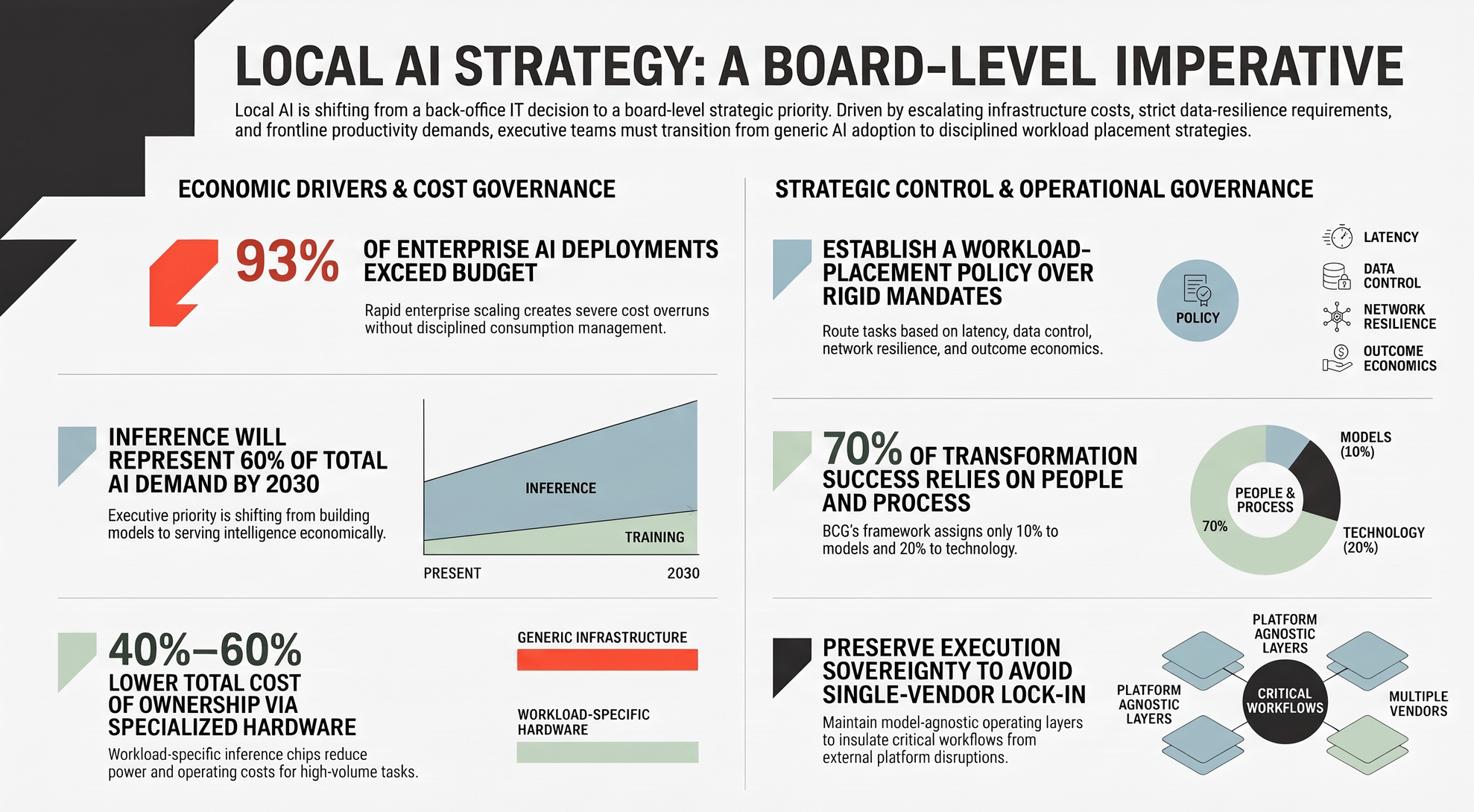
Table of Contents
- Technology Potential & Capabilities Determine which workloads belong in the cloud, on enterprise infrastructure, at the edge, or on employee and customer devices.
- Human Resources & Skills Development Prepare leaders and frontline teams to use, challenge, audit, and escalate AI-supported decisions.
- Business Model Transformation Assess how model portability, execution sovereignty, and locally controlled intelligence could strengthen competitive positioning.
- Investment & Return on Investment Evaluate Local AI through cost per business outcome, lifecycle expenditure, utilization, and measurable operating performance.
- Industry Applications Examine where Local AI is already improving field service, industrial operations, transport, utilities, and other decision-intensive environments.
- Cross-Article Strategic Synthesis Consensus map and strategic tensions across the six firms.
Technology Potential & Capabilities
Determine which workloads belong in the cloud, on enterprise infrastructure, at the edge, or on employee and customer devices.
Edge Inference — Running a trained AI model near the point where data is created, such as a factory, vehicle, retail location, or employee device.
Strategic Core
Local AI deployment should follow workload-specific placement criteria rather than a fixed cloud-versus-edge strategy. Each workload requires a decision based on latency, connectivity, data sensitivity, reliability, and cost per useful outcome.
Cloud infrastructure remains appropriate for elastic demand and complex models. Enterprise-hosted, edge, and device deployment become stronger options when data cannot move freely, decisions must be immediate, or network availability is uncertain.
McKinsey recommends treating infrastructure as a full-stack economic decision. Forrester adds that the surrounding platform matters more than any temporary lead in model performance.
Strategic Insights
McKinsey expects inference to represent approximately 60% of AI demand by 2030. This shifts the executive focus from training increasingly large systems to serving intelligence reliably and economically.
PwC estimates that workload-specific inference chips can deliver 40%–60% lower total cost of ownership than GPU-based alternatives, up to 50% greater power efficiency, and operating-cost savings of approximately 10%–20%.
Specialized inference chips offer the strongest economic potential at scale, particularly for workloads with predictable requirements. Specialized chips risk becoming outdated when AI model architectures evolve faster than chip development cycles.
- Classify AI workloads by latency, data control, reliability, and cost per useful outcome before selecting cloud, enterprise, edge, or device deployment.
- Evaluate the governance, security, orchestration, observability, and switching capabilities of the platform—not only model accuracy.
- Evaluate specialized inference hardware based on workload requirements, energy efficiency, and total cost of ownership before investing.
Which of our AI workloads genuinely require local execution, and which are being localized without a measurable business reason?
Human Resources & Skills Development
Prepare leaders and frontline teams to use, challenge, audit, and escalate AI-supported decisions.
AI Fluency — The ability to use AI effectively, challenge its output, recognize risk, and escalate exceptions without requiring employees to become technical specialists.
Strategic Core
Local AI changes frontline work as much as it changes infrastructure. It places AI recommendations directly inside maintenance, inspection, customer-service, and operational workflows.
That raises the importance of role design, decision rights, and escalation paths. Employees need to know when to accept an AI recommendation, when to override it, and how to document the decision.
BCG recommends codesigning tools with frontline teams and scaling them through local champions. McKinsey similarly emphasizes leadership alignment, workforce adoption, and enterprise-wide AI fluency.
Strategic Insights
BCG's 10-20-70 framework allocates 10% of transformation effort to models, 20% to technology and data, and 70% to people and processes.
In one field-service case, BCG reports that annual revenue growth increased from 5% to more than 15% and EBIT doubled within 12 months. These results come from a consultant-supported case and should be treated as directional rather than universally reproducible.
McKinsey's executive interviews reinforce the operating principle: technology teams cannot deliver enterprise transformation without business ownership and employee participation.
- Assign accountable business owners and frontline champions before deployment begins.
- Make AI fluency, responsible use, and escalation training part of core workforce development.
- Measure adoption through usage, override frequency, exception rates, and quality outcomes—not training completion alone.
Which managers and frontline employees must help design the workflow if Local AI is to become trusted rather than merely installed?
Business Model Transformation
Assess how model portability, execution sovereignty, and locally controlled intelligence could strengthen competitive positioning.
Execution Sovereignty — An organization's ability to operate critical AI workloads without depending entirely on one model provider, cloud platform, or jurisdiction.
Strategic Core
Local AI can change the operating model by converting embedded data, proprietary workflows, and physical assets into defensible capabilities.
The objective is not ownership for its own sake. It is the ability to route work between models, protect sensitive processes, and continue operating when pricing, capacity, regulation, or provider access changes.
BCG recommends a portfolio of no-regret capabilities, contained options, and selective strategic bets.
Bain & Company frames local infrastructure as part of national and corporate sovereignty. Forrester cautions that durable advantage resides in the operational platform rather than any individual open model.
Strategic Insights
BCG reports that open-source models' share of tokens routed through OpenRouter increased from approximately 10% to 42% between October 2024 and June 2026. This suggests increasing developer interest in model choice, although one routing platform is not a proxy for total enterprise adoption.
Bain & Company reports that local providers represent nearly one-quarter of planned new computing capacity and that governments had ordered at least 40,000 GPUs during the period studied. Capacity announcements do not guarantee utilization or financial return.
The strategic value lies in preserving options while avoiding stranded infrastructure.
- Maintain a model-agnostic operating layer and test at least one credible fallback for critical workflows.
- Define which workloads require local control for regulatory, continuity, or competitive reasons.
- Invest in governance and orchestration before treating open-weight models as an enterprise platform.
Which AI capabilities must remain portable or locally controllable to protect our operating model?
Investment & Return on Investment
Evaluate Local AI through cost per business outcome, lifecycle expenditure, utilization, and measurable operating performance.
AI FinOps — The management discipline that connects AI consumption, infrastructure costs, performance, risk, and business outcomes.
Strategic Core
Local AI should not be approved on privacy or speed claims alone. It needs a business case based on cost per resolved case, inspected unit, completed transaction, or productive employee hour.
The comparison must include hardware, energy, integration, monitoring, model updates, device replacement, security, and support.
McKinsey recommends a centralized control plane that links spend and consumption with measurable outcomes. PwC shows that specialized inference infrastructure can improve economics, but only where utilization and workload stability support the investment.
Strategic Insights
McKinsey reports that AI spending increases nearly fourfold as organizations move from isolated use cases to enterprise deployment, while 93% of qualified survey respondents exceeded their budgets.
The survey included 120 enterprise participants, of whom 75 qualified, across five industries. McKinsey estimates that disciplined consumption management can reduce AI costs by 20%–30%.
PwC's estimated 40%–60% TCO advantage for customized inference chips should be stress-tested against utilization, obsolescence, switching costs, and integration requirements.
- Require every Local AI proposal to state its business outcome, unit-cost baseline, utilization assumption, and scale trigger.
- Use smaller or locally hosted models for predictable workloads only after quality and risk thresholds are validated.
- Treat custom hardware as an investment case requiring sensitivity analysis, not as a default technology upgrade.
Can we currently calculate AI cost per useful business outcome, or are we still managing only invoices and infrastructure?
Industry Applications
Examine where Local AI is already improving field service, industrial operations, transport, utilities, and other decision-intensive environments.
Physical AI — AI embedded in equipment, vehicles, devices, or operational environments where it interprets local conditions and supports or initiates action.
Strategic Core
The strongest Local AI cases are emerging where data is generated outside the data center and decisions cannot wait for a remote system. Field service, industrial maintenance, transport, energy, and utilities are natural starting points.
These environments benefit from offline operation, rapid response, local data control, and access to institutional knowledge at the point of work. They also carry higher consequences when a recommendation is wrong.
Deployment therefore requires human escalation, explainability, secure updates, identity controls, audit logs, and fail-safe operating procedures.
BCG emphasizes full workflow redesign. Deloitte illustrates the need for hybrid infrastructure in regulated critical systems.
Strategic Insights
BCG estimates that AI-first field service can raise productivity by 20%–30% and profit per technician by as much as 80%. In one transport deployment, BCG reports a 40% reduction in rework and 25% faster maintenance execution. These figures are consultant-reported case results.
Deloitte's 2026 outlook, citing Gartner, expects nearly 40% of utility control rooms to use AI by 2027. Utilities are combining edge systems, secure on-premises environments, cloud capacity, and federated learning rather than standardizing on a single deployment location.
- Select an initial workflow where latency, offline operation, safety, or data residency produces a clear advantage.
- Track rework, cycle time, first-time resolution, equipment availability, exception rates, and safety events.
- Retain human authority and auditable escalation for decisions affecting critical infrastructure or safety.
Which operational decision would improve most if trusted intelligence were available at the exact point of work?
Cross-Article Strategic Synthesis
Where the advisory firms agree — and where they diverge.
Strategic Consensus Map
The sources converge on four principles:
- Hybrid deployment will dominate. Cloud, enterprise infrastructure, edge systems, and devices serve different workload requirements.
- Economics must be measured at the outcome level. Token price and hardware performance are incomplete without cost per case, transaction, inspection, or resolution.
- Portability reduces strategic exposure. Open standards, model routing, fallbacks, and observable control planes protect against pricing, capacity, and access changes.
- People and process determine value realization. Workflow redesign, training, decision rights, and adoption mechanisms consistently receive more emphasis than model selection.
Strategic Tensions Analysis
Where the firms diverge, and what that divergence means for executive decision-making:
- "Move early" vs "Wait for better economics." BCG argues that delay erodes organizational options. McKinsey finds that edge technology is ready while commercial responsibility and payment models remain unsettled.
- "Customize" vs "Preserve adaptability." PwC identifies potentially material savings from custom inference hardware. McKinsey warns that chip-development cycles can outlast the model architecture they were designed to serve.
- "Pursue sovereignty" vs "Maximize utilization." Bain & Company sees local capacity as strategically important but also identifies overcapacity risk.
- "Adopt open weights" vs "Buy an integrated platform." Forrester sees open models as valuable components while arguing that integrated governance and operational tooling remain decisive.
Executive Reflection
The strategic advantage is not simply running AI locally. It comes from deciding which workloads require local control—and institutionalizing the governance needed to operate them safely.
Sources & References
Primary sources
- McKinsey & Company — "The Future of AI Workloads" https://www.mckinsey.com/featured-insights/charts/the-future-of-ai-workloads
- McKinsey & Company — "The Cost of Intelligence: How CIOs Can Manage AI Demand at Scale · Jul 2026" https://www.mckinsey.com/capabilities/tech-and-ai/our-insights/the-cost-of-intelligence-how-cios-can-manage-ai-demand-at-scale
- McKinsey & Company — "Frontiers of Compute: The Technologies to Reduce AI Inference Costs · 2026" https://www.mckinsey.com/industries/semiconductors/our-insights/frontiers-of-compute-the-technologies-to-reduce-ai-inference-costs
- McKinsey & Company — "How the Best CEOs Are Meeting the AI Moment (The McKinsey Podcast)" https://www.mckinsey.com/capabilities/tech-and-ai/our-insights/how-the-best-ceos-are-meeting-the-ai-moment
- BCG — "AI-First Field Service Operations · Jul 2026" https://www.bcg.com/publications/2026/reinventing-service-operations-with-ai
- BCG — "AI Fuels Field Service Transformation. Change Management Provides the Spark · Jan 2026" https://www.bcg.com/publications/2026/ai-fuels-field-service-transformation
- BCG — "A Portfolio Strategy for AI Investment Risk · 2026" https://www.bcg.com/publications/2026/portfolio-strategy-ai-investment-risk
- PwC — "Who Will Innovate the Next Wave of AI Semiconductors?" https://www.pwc.com/gx/en/industries/technology/next-wave-of-ai-semiconductor.html
- Bain & Company — "Sovereign AI Is the Next Fault Line in the Global Tech Sector · Technology Report 2024" https://www.bain.com/insights/sovereign-ai-is-the-next-fault-line-in-the-global-tech-sector-tech-report-2024/
- Forrester — "Open-Weight Models Are Proliferating, But the Platform Race Matters More · Oct 2026" https://www.forrester.com/blogs/open-weight-models-are-proliferating-but-the-platform-race-matters-more/
- Deloitte Insights — "2026 Power and Utilities Industry Outlook" https://www.deloitte.com/us/en/insights/industry/power-and-utilities/power-and-utilities-industry-outlook.html