
Why Is AI Sovereignty Becoming a Strategic Priority for Business Leaders?
How control over AI infrastructure, data, and technology dependencies is reshaping business resilience, investment decisions, and competitive advantage.


How executives can balance technological independence, business resilience and return on AI investment.
AI sovereignty is rapidly becoming a boardroom decision, with direct implications for business continuity, regulatory exposure, and capital allocation. As organizations embed AI into critical operations, dependence on external technology providers is creating new strategic vulnerabilities. The economics are significant: McKinsey estimates sovereign AI solutions can carry a 10–30% cost premium, while Gartner forecasts widespread adoption of digital sovereignty strategies among regulated organizations by 2030. Yet the consulting perspective is not unanimous on how far independence should extend. BCG emphasizes resilience over full technological ownership, while Strategy& provides a framework for deciding what to control, secure through partnerships, or leave to global providers. This issue examines the technology choices, workforce capabilities, operating-model changes, investment trade-offs, and industry applications shaping AI sovereignty—and the decisions executives should prioritize before technology dependencies become more difficult and costly to reverse.
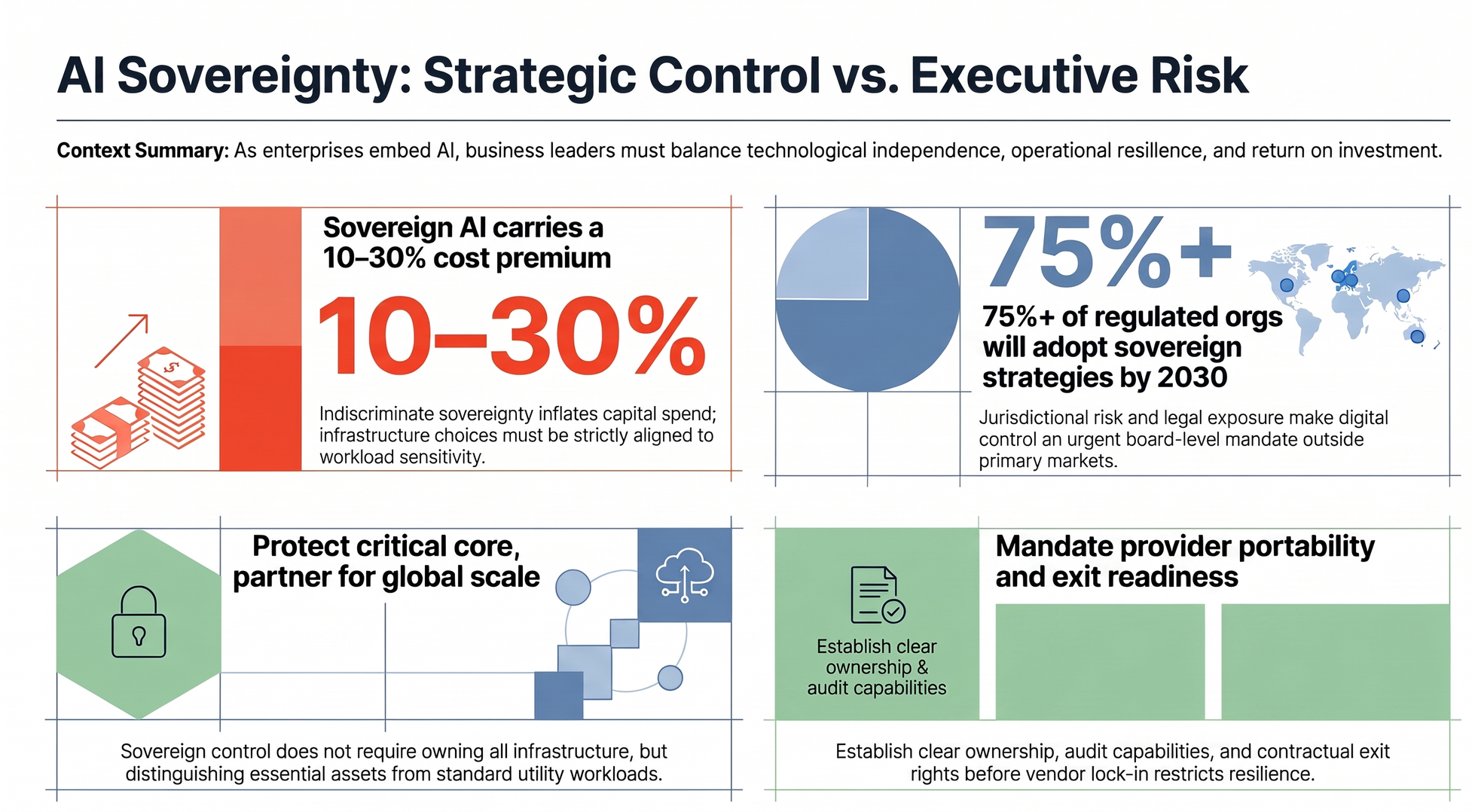
Table of Contents
- Technology Potential & Capabilities How businesses can secure critical AI infrastructure, data, and models while preserving access to global innovation.
- Human Resources & Skills Development Why internal AI expertise, governance capabilities, and operational accountability are essential to meaningful technological independence.
- Business Model Transformation How AI sovereignty is reshaping supplier relationships, operating models, and enterprise flexibility across jurisdictions.
- Investment & Return on Investment How executives can evaluate sovereignty costs, protect capital efficiency, and justify investment through measurable business value.
- Industry Applications Where stronger AI control matters most across financial services, healthcare, energy, telecommunications, and critical infrastructure.
- Cross-Article Strategic Synthesis The strategic consensus, and the tension between domestic ownership and practical resilience.
The leadership imperative: AI sovereignty is not a mandate to own every technology. It is a requirement to understand which dependencies could compromise enterprise value—and to establish the controls needed before those dependencies become strategic constraints.
Technology Potential & Capabilities
Building Control Without Sacrificing Innovation
Sovereign AI refers to the ability to exercise appropriate control over AI infrastructure, data, models and operations.
Data residency concerns where information is physically stored or processed.
Model portability is the ability to move or replace AI models without becoming dependent on one provider.
Strategic Core
AI sovereignty does not require businesses to own their entire technology infrastructure. It requires distinguishing critical workloads that demand stronger control from lower-risk workloads that can benefit from global platforms. McKinsey identifies four dimensions of sovereignty: territorial, operational, technological and legal. Strategy& complements this approach with four strategic choices: assure access, control critical components, partner with technology providers and influence the ecosystem.
Together, these frameworks support a selective architecture that protects sensitive operations while preserving access to global AI innovation. Executives should assess workload sensitivity and define control, portability and continuity requirements before committing to AI infrastructure.
Strategic Insights
The economic trade-offs are substantial. McKinsey reports a 10–30% cost premium for sovereign AI offerings and typical migration periods of three to four years. These figures suggest that sovereign deployment should follow an assessment of workload sensitivity rather than a blanket technology policy. Forrester identifies AI sovereignty as a growing strategic priority, extending beyond infrastructure to models, data, vendor ecosystems and operations. The strategic opportunity is to combine proportionate protection with interoperability and provider flexibility, reducing dependencies while preserving access to innovation. Greater AI sovereignty should not be assumed to improve performance or financial returns; its value depends on the risks addressed and the costs incurred.
- Classify AI workloads according to sensitivity, business criticality and legal exposure before selecting infrastructure or providers.
- Institutionalize provider portability, exit rights and continuity safeguards as part of enterprise architecture decisions.
Which AI capabilities are sufficiently critical to justify greater technological control?
Human Resources & Skills Development
Sovereignty Requires Organizational Capability
AI operating capability is the combination of people, processes and expertise needed to deploy, manage and audit AI.
AI governance establishes accountability, policies and controls for its responsible use.
Skills sovereignty describes an organization's ability to retain the expertise needed to operate critical AI systems without excessive external dependence.
Strategic Core
Technology ownership offers limited protection if an organization lacks the people required to operate, maintain and govern its systems. KPMG identifies talent, intellectual property, governance and local innovation capacity as essential elements of a sovereign AI ecosystem. Deloitte similarly connects AI transformation to changes in work, accountability and operating practices.
Executives should establish coordinated capabilities across AI technology, risk governance, procurement and business operations to maintain effective control over critical AI systems. Organizations should retain critical AI expertise and reduce excessive dependence on external providers for operating and governing essential AI systems. Skills development must accompany AI investment from the outset.
Strategic Insights
Workforce transformation is progressing, but organizational change remains uneven. In its enterprise AI research, Deloitte reports that 60% of surveyed organizations have redesigned jobs around AI to at least a moderate degree, while only 15% report extensive or complete redesign. These findings concern AI transformation broadly, not sovereign AI specifically. Together, Deloitte and KPMG highlight a critical implementation gap: AI deployment must be accompanied by operational skills, clear accountability and effective governance. KPMG reinforces the need to integrate sovereign AI into institutional processes, procurement, innovation ecosystems and ongoing operations. These capabilities can strengthen internal control and reduce dependence on external providers for critical AI operations.
- Assign clear ownership for AI oversight, with approval, monitoring and escalation processes aligned with each system’s level of autonomy.
- Develop internal expertise in AI governance, model evaluation, infrastructure operations and AI procurement alongside technology investments.
Does our organization have the internal expertise to maintain control over its most critical AI operations?
Business Model Transformation
From Technology Dependency to Strategic Flexibility
Vendor lock-in occurs when changing technology providers becomes prohibitively expensive or operationally difficult.
Hybrid AI architecture combines different infrastructure or provider arrangements according to business requirements.
Operational resilience is the ability to maintain or restore critical business services during disruption.
Strategic Core
AI sovereignty is reshaping how businesses organize technology procurement, supplier relationships and enterprise risk. Accenture argues that organizations can no longer assume one global AI strategy will meet every market's requirements. Instead, leaders should adopt sovereignty policies that reflect geography, sector and use case. BCG challenges the pursuit of complete technological independence and emphasizes resilience through diversified partnerships, local implementation capabilities and trusted governance.
Together, these perspectives support a more flexible approach to AI infrastructure, provider relationships and operational resilience. Executives should assess critical technology dependencies and determine where to maintain global partnerships, diversify providers or strengthen direct control.
Strategic Insights
The strategic opportunity is to reduce business exposure without making unnecessary investments in proprietary infrastructure. BCG draws on an analysis of AI policy actions across more than 30 countries and identifies infrastructure, trust, adoption and partnerships as major components of AI resilience. This is a national-policy analysis, not a controlled study of enterprise profitability. Gartner forecasts that more than 75% of regulated organizations outside the United States and China will adopt digital sovereignty strategies by 2030. This trend reinforces the need for flexible AI architectures and provider arrangements that accommodate different jurisdictional requirements.
Organizations that diversify provider relationships and maintain service continuity can strengthen operational resilience and adapt more effectively to regulatory requirements across markets.
- Diversify critical AI-provider dependencies and establish viable alternatives to maintain operational continuity.
- Integrate AI sovereignty into enterprise strategy and technology sourcing decisions, adapting provider and infrastructure choices to geography, industry and use case.
How would our business model change if a critical AI provider became unavailable or subject to new restrictions?
Investment & Return on Investment
Measuring the Economic Value of Control
Total cost of ownership (TCO) includes acquisition, implementation, operation, upgrades and migration costs.
Return on investment (ROI) evaluates financial benefits against investment costs.
Risk-adjusted investment considers financial returns alongside the potential consequences of disruption, dependency and regulatory exposure.
Strategic Core
AI sovereignty introduces an additional financial decision: how much protection is economically justified for a particular business capability. McKinsey cautions against applying sovereign requirements indiscriminately, while BCG highlights the danger of investing heavily in technology assets that may become obsolete. KPMG connects scaled AI value creation with management infrastructure, accountability and stronger cost oversight.
Together, these findings support evaluating sovereign AI investments through their costs, expected business value and exposure to operational and technology risks. Executives should assess the incremental cost of sovereign AI against the potential business impact of provider dependency, legal restrictions and service disruption. Sovereignty spending should remain accountable to measurable outcomes.
Strategic Insights
Investment discipline is becoming increasingly important. KPMG, surveying more than 2,100 senior leaders, reports that 86% of organizations with established AI ROI operate a formal cross-functional or enterprise-wide AI management layer, versus 31% among organizations at the experimentation stage. This demonstrates an association between organizational maturity and structured AI management, not a causal sovereign-AI return. Meanwhile, PwC projects US$31.6 trillion in cumulative global data-centre capital expenditure through 2050, driven largely by growing AI demand and recurring technology upgrades. This is an infrastructure-market forecast, not a sovereign-AI revenue estimate. Combined with McKinsey's estimated sovereignty premium, these findings reinforce the need to assess sovereign AI investments against lifecycle costs, provider flexibility and technology obsolescence risks.
- Assess major sovereign AI investments against incremental costs, workload sensitivity and the business risks of provider dependency or service disruption.
- Measure AI costs against business outcomes consistently across initiatives, with clear reporting of value realization to leadership.
What financial value would greater AI independence create, and how should that value be measured?
Industry Applications
Sovereignty Where Business Exposure Is Highest
Critical infrastructure refers to essential systems whose disruption could cause significant economic or societal consequences.
Regulated AI involves applications subject to sector-specific legal, supervisory or compliance requirements.
Jurisdictional risk arises when different legal systems can affect technology access, data or operations.
Strategic Core
AI sovereignty requirements vary according to industry, workload sensitivity and business criticality. Sensitive industries may need stronger control over data, operations and access rights than organizations using AI primarily for routine productivity. Deloitte identifies national security, healthcare information, financial systems and critical infrastructure as areas where sovereign requirements may be justified. Gartner emphasizes operational resilience when access to essential technologies is interrupted. KPMG outlines how national AI strategies can integrate sovereign infrastructure, trusted governance and scalable public-service delivery.
Business leaders should distinguish legal and regulatory obligations from risk-based sovereignty choices, aligning controls with workload sensitivity and operational criticality.
Strategic Insights
AI sovereignty can have significant operational implications in critical sectors, although the cited sources do not quantify comparable sector-level financial returns. In its Canadian analysis, Deloitte highlights energy grids, telecommunications, satellites, financial systems and government operations as examples of infrastructure where resilience can justify additional requirements. Gartner identifies a broader shift toward technology arrangements designed for continuity and viable provider exits. Forrester also links inadequate sovereignty planning to potential regulatory lockouts, vendor dependency and constrained innovation.
The cited public sources primarily identify strategic risks and resilience priorities rather than comparable, quantified outcomes from enterprise deployments. Executives should prioritize sovereignty controls for sensitive and critical AI applications, focusing on data protection, service continuity and applicable regulatory requirements.
- Prioritize sovereignty assessments for systems handling sensitive information or supporting critical business operations.
- Assess viable alternatives to critical AI providers and regularly test their sovereign-delivery commitments to protect service continuity.
Which of our industry-specific AI applications would create the greatest business exposure if access or operational control were disrupted?
Cross-Article Strategic Synthesis
The Strategic Consensus
The research points to a consistent conclusion: AI sovereignty is most valuable when applied selectively to critical business dependencies.
- McKinsey, BCG, Strategy& and Gartner converge on the need for calibrated control, technology resilience and lower dependency concentration. Accenture extends this conversation to enterprise strategy and board oversight.
- These perspectives reinforce three management principles: sovereignty must reflect workload sensitivity; resilience requires viable alternatives to critical dependencies; and investment decisions must preserve both operational control and access to innovation.
- There is no universal target for sovereign-AI spending, adoption timing or financial return. Requirements depend on the business model, sector, jurisdiction and the consequences of technology disruption.
Strategic Tension — Domestic Ownership versus Practical Resilience
A key strategic tension lies between building domestic AI capabilities and prioritizing practical resilience.
BCG emphasizes resilience over full technology ownership, warning against costly and potentially obsolete investments. KPMG places greater emphasis on developing domestic infrastructure, talent, intellectual property and governance while recognizing the value of global partnerships. Strategy& offers a pragmatic middle path, balancing direct control of critical capabilities with assured access and strategic partnerships.
These perspectives are complementary rather than fundamentally opposed: effective AI sovereignty requires selective domestic control, resilient dependencies and continued access to global innovation.
Their methodologies also differ. BCG and Strategy& emphasize national technology strategy and comparative policy assessment; McKinsey combines strategic analysis with cost and implementation estimates; KPMG draws on surveys and national ecosystem studies; Gartner provides forecasts; Deloitte examines sector and operational considerations. These findings should not be treated as interchangeable proof of enterprise-level ROI.
Sources & References
Primary sources
- McKinsey & Company — "Sovereign AI: Building Ecosystems for Strategic Resilience and Impact · 2026" https://www.mckinsey.com/industries/technology-media-and-telecommunications/our-insights/sovereign-ai-building-ecosystems-for-strategic-resilience-and-impact
- McKinsey & Company — "Governments Want to Safeguard Their Tech—But Not All AI Should Be Sovereign · Nov 2026" https://www.mckinsey.com/industries/public-sector/our-insights/rewiring-government-blog/governments-want-to-safeguard-their-tech-but-not-all-ai-should-be-sovereign
- BCG Henderson Institute — "For Most Countries, AI Sovereignty Is an Illusion. Resilience Is Real. · Mar 2026" https://www.bcg.com/publications/2026/ai-sovereignty-is-an-illusion-resilience-is-real
- Strategy& (PwC network) — "Pragmatic AI Sovereignty: Architecting AI Value Chains for Control and Continuity in the Gulf Countries · Aug 2026" https://www.strategyand.pwc.com/m1/en/industries/technology/pragmatic-ai-sovereignty.html
- PwC — "Global Investment in AI Infrastructure to Hit US$31.6 Trillion Through 2050 (Global Data Centre Outlook 2026–50) · Sept 2026" https://www.pwc.com/gx/en/news-room/press-releases/2026/global-investment-in-ai-infrastructure.html
- Gartner — "SovereignTech Enables a Future of Digital Resilience · Nov 2026" https://www.gartner.com/en/articles/sovereigntech-digital-resilience
- Forrester — "Sovereign AI Is About Control, Not Localization · Jul 2026" https://www.forrester.com/blogs/sovereign-ai-is-about-control-not-localization/
- KPMG in India — "Sovereign by Design: Building India's Independent, Inclusive and Future-Ready AI · Oct 2026" https://kpmg.com/in/en/insights/2026/10/sovereign-by-design-building-indias-independent-inclusive-and-future-ready-ai.html
- KPMG International — "Global AI Pulse Q3 2026: As AI Maturity Converges, Leading Organizations Show What AI at Scale Requires · Sept 2026" https://kpmg.com/xx/en/media/press-releases/2026/09/new-kpmg-ai-pulse-survey-as-ai-maturity-converges-leading-organizations-show-what-ai-at-scale-requires.html
- Deloitte AI Institute — "The State of AI in the Enterprise — Built Differently · Oct 2026" https://www.deloitte.com/us/state-of-ai
- Deloitte Canada — Future of Canada Centre — "Canadian AI Sovereignty: A Dose of Realism · Feb 2026" https://www.deloitte.com/ca/en/our-thinking/future-of-canada-center/canadian-ai-sovereignty.html
- Accenture — "Sovereign AI: Own Your AI Future · Nov 2025" https://www.accenture.com/en/insights/technology/sovereign-ai