
Why Is the AI Operating Model Becoming the New Competitive Advantage?
AI operating model redesign is becoming central to enterprise AI value.


AI is moving from a technology deployment question to an operating-model decision.
Productivity is already improving, but financial results remain uneven: McKinsey finds a substantial gap between individual productivity gains and reported EBIT impact. The next competitive window therefore sits beyond tool adoption. Executives must determine which workflows to redesign, how work should be divided between people and AI, where decision authority should sit, how returns will be audited, and which controls must be institutionalized before scale. Across Accenture, BCG, PwC, Gartner, KPMG, EY, and McKinsey, the direction is clear: advantage is shifting toward organizations that can redesign work, orchestrate human and AI capacity, measure economics at process level, and govern execution without slowing it down. Early transformation cases suggest material improvements in planning speed, workflow automation, capacity release, and service economics. The strategic issue is now whether leadership teams can operationalize those gains before AI capabilities become broadly accessible to competitors.
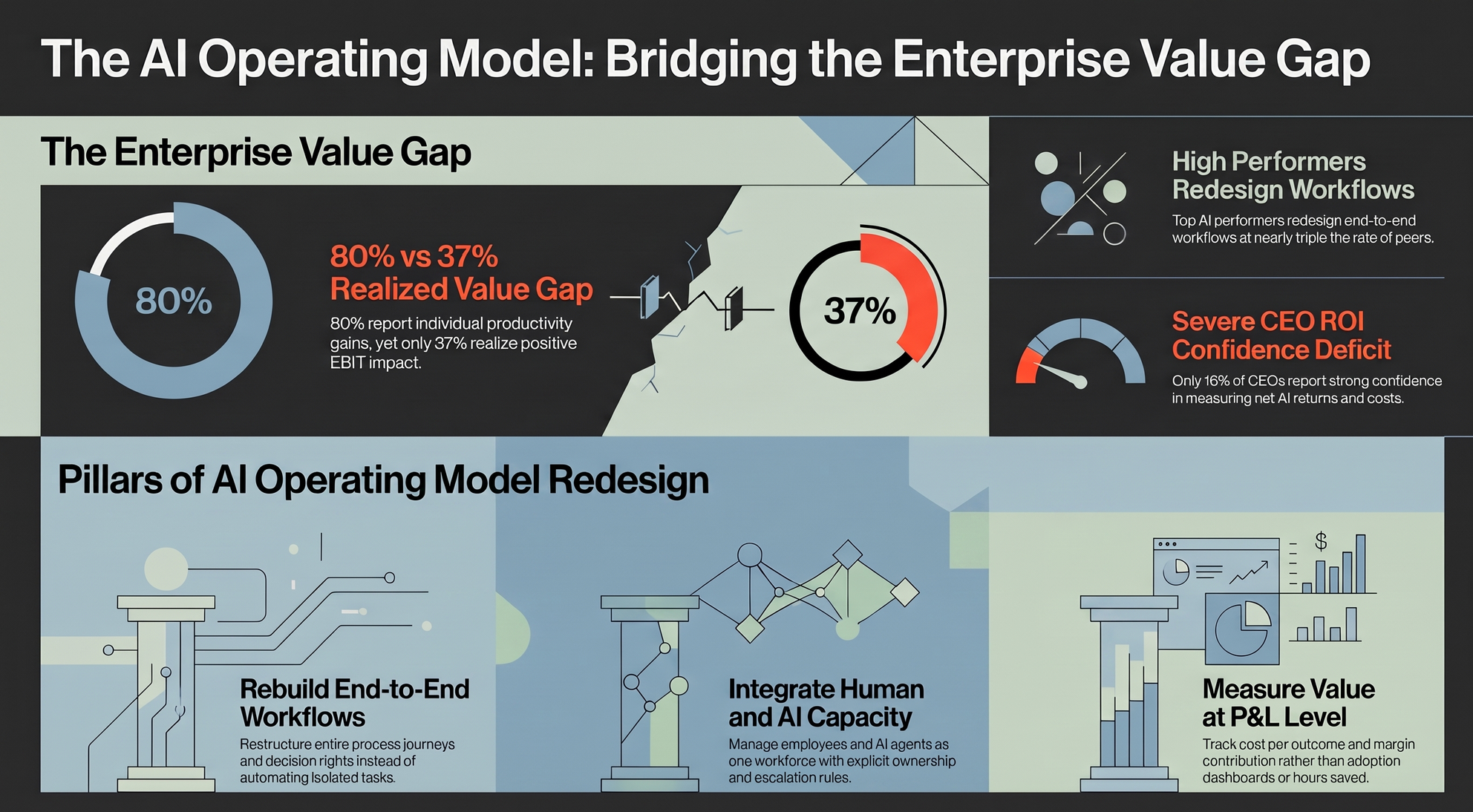
The signal is consistent: AI adoption is accelerating faster than the organizational systems required to convert it into sustained enterprise performance.
What This Issue Covers
- Technology Potential & Capabilities How enterprise AI is evolving from isolated tools into an operating layer that can orchestrate data, decisions, workflows, and management processes.
- Human Resources & Skills Development Why workforce strategy must move beyond AI training toward redesigning roles, accountability, management structures, and human–AI capacity.
- Business Model Transformation How companies can use AI operating-model redesign to strengthen distinctive capabilities, remove legacy friction, and create harder-to-replicate competitive advantages.
- Investment & Return on Investment Why adoption and productivity metrics are no longer sufficient, and how executives can connect AI spending to process economics, margin, cash flow, and auditable business outcomes.
- Industry Applications Where end-to-end workflow redesign is beginning to produce tangible operating impact across financial services, industrials, energy, healthcare, and consumer businesses.
- Cross-Article Synthesis
AI Operating Model Redesign: Why Enterprise AI Value Depends on How Work Gets Done
Enterprise AI adoption is accelerating. Enterprise value is not keeping pace.
That gap is becoming an operating-model issue. McKinsey reports that 80% of respondents see individual productivity improvements from AI, yet only 37% report a positive EBIT impact. Just 6% qualify as AI high performers. Nearly three-quarters of those high performers substantially redesign workflows, compared with roughly one-quarter of other organizations.
The implication for CEOs is increasingly clear. Deploying more AI is unlikely to be enough. Organizations need to redesign workflows, decision rights, workforce structures, economic measurement, and governance around what AI can now do.
The emerging competitive advantage is not access to AI. It is the ability to institutionalize AI inside the operating model without losing accountability, financial discipline, or human judgment.
- Redesign end-to-end work, not isolated tasks. AI value compounds when workflows, decisions, roles, controls, and incentives change together.
- Treat people and AI agents as one productive system. Every meaningful agent needs ownership, decision rights, performance metrics, and escalation thresholds.
- Measure value at the process and P&L level. Hours saved and adoption rates are activity metrics. Cost per outcome, cycle time, quality, revenue, margin, and cash conversion are stronger measures.
- Embed governance before scale. Risk, security, auditability, access controls, and human oversight belong inside the operating model rather than beside it.
Technology Potential & Capabilities
How enterprise AI is evolving from isolated tools into an operating layer that can orchestrate data, decisions, workflows, and management processes.
AI operating model — An AI operating model defines how strategy, people, processes, decision rights, governance, data, technology, and AI systems work together to produce business outcomes. It goes beyond deploying AI tools. It determines where AI advises, executes, learns, and escalates to humans.
Strategic Core
The technology opportunity is shifting from standalone assistants toward enterprise-wide orchestration. McKinsey describes an AI operating system as a persistent management layer that combines enterprise context, proprietary knowledge, data, and decision support. Gartner reaches a similar conclusion from an operating-model perspective: organizations need shared platforms, reliable data, coordinated governance, and redesigned workflows rather than fragmented tools. BCG adds an important constraint. Technology architecture matters, but enterprise performance depends equally on strategic clarity, organizational change, and the ability to operate AI reliably at scale.
Strategic Insights
Early evidence suggests that orchestration can materially compress management and planning cycles, but these results remain company-specific. McKinsey reports that early AI operating-system deployments accelerated planning cycles by up to 10 times, produced first value in about 12 weeks, and reduced time to ROI in subsequent domains by 50%. The same research finds that 40% of respondents at large companies have scaled AI agents, while only 6% attribute at least 5% of EBIT to AI. BCG reports that 95% of its more advanced “future-built” organizations are undergoing data transformation and more than two-thirds are committing to a common enterprise AI platform and control plane.
- Prioritize a small number of high-value business domains and build reusable enterprise intelligence, governance, and orchestration capabilities around them.
- Align technology deployment with process, structure, talent, performance measures, and governance before scaling.
- Build enterprise architecture for governed execution, not simply model access or isolated automation.
Human Resources & Skills Development
Why workforce strategy must move beyond AI training toward redesigning roles, accountability, management structures, and human–AI capacity.
Human–AI workforce — A human–AI workforce treats employees and AI agents as complementary sources of productive capacity. Human accountability remains explicit, while tasks, decisions, and execution are allocated according to risk, judgment requirements, capability, and economics.
Strategic Core
AI workforce transformation is broader than reskilling. It changes how jobs are constructed, how expertise develops, how managers coordinate work, and how organizations plan capacity. McKinsey argues that roles should increasingly be organized around outcomes rather than inherited task bundles. Accenture recommends integrating people and agents into one workforce view, with every agent assigned a human owner. EY reinforces the workforce issue from the CEO perspective: most executives surveyed expect AI to change skills, roles, and ways of working more profoundly than overall workforce size.
Strategic Insights
The workforce bottleneck is becoming measurable. In a survey of 3,000 C-suite leaders, Accenture reports that 58% plan to change how work is distributed between people and AI within the next 12 months. In a survey of 1,200 CEOs across 21 countries, EY finds that 80% expect AI to affect roles, skills, and working methods more than workforce size; 47% say AI skills are not developing fast enough, and 72% expect skills shortages to become a greater growth constraint than access to capital. McKinsey also finds a readiness gap: 70% of respondents report personal readiness for AI, compared with 27% of leaders who consider their organizations ready for the required change.
- Redesign roles around outcomes and explicitly protect the human judgment, expertise, and apprenticeship mechanisms that AI should not erode.
- Create a combined workforce view covering people, agents, capability, cost, performance, ownership, and escalation.
- Treat AI capability building as an enterprise growth requirement, including AI literacy at executive and board level.
Business Model Transformation
How companies can use AI operating-model redesign to strengthen distinctive capabilities, remove legacy friction, and create harder-to-replicate competitive advantages.
AI-first business redesign — AI-first business redesign starts with the outcome or customer need and rebuilds the workflow, economics, roles, decisions, and controls around what AI now makes possible. It differs from adding AI to an unchanged legacy process.
Strategic Core
The strategic opportunity extends beyond productivity. PwC argues that generic access to the same AI models will not create durable differentiation. Competitive advantage must come from proprietary data, unique distribution, trusted execution, institutional knowledge, or business-model innovation. BCG reaches a complementary conclusion: organizations should redesign themselves for AI rather than fitting AI into existing structures. Governance is part of that redesign. KPMG finds that stronger performers are more likely to embed governance, trust, and accountability directly into workflows and decisions instead of treating them as separate compliance activities.
Strategic Insights
Business-model advantage depends on concentration, not indiscriminate deployment. PwC recommends concentrating capital on areas capable of creating differentiated value instead of distributing AI funding evenly across functions. It identifies potential value pools across financial services, industrials, healthcare, consumer markets, and technology. KPMG reports that 58% of surveyed leaders view enterprise-wide capabilities as critical, yet only 12% believe their organizations deliver them effectively. It also finds that only 24% proactively integrate risk management into strategy and the technology lifecycle. The strategic challenge is therefore dual: redesign for differentiation while keeping execution governable.
- Concentrate AI investment on capabilities that can strengthen the core business, create new value pools, or establish difficult-to-copy advantages.
- Rebuild high-value workflows around the potential of AI instead of automating legacy complexity.
- Institutionalize governance inside operating decisions so that risk controls scale with AI-enabled business change.
Investment & Return on Investment
Why adoption and productivity metrics are no longer sufficient, and how executives can connect AI spending to process economics, margin, cash flow, and auditable business outcomes.
Net AI value — Net AI value is the economic benefit remaining after the full cost of redesigning, deploying, operating, controlling, and adopting AI-enabled work. It is more demanding than measuring productivity or hours saved.
Strategic Core
AI investment governance is moving from experimentation metrics toward business economics. PwC argues that adoption, use-case counts, and hours saved do not demonstrate economic value unless the gains reach revenue, margin, or cash flow. Accenture recommends measuring cost per outcome by combining employee, agent, and inference costs against what a value stream actually delivers. BCG similarly recommends measuring AI through the P&L or business KPIs. Together, these approaches shift the CFO conversation from “How much AI are we using?” to “What business outcome changed, what did it cost, and can we reproduce it?”
Strategic Insights
The measurement gap remains significant. EY finds that only 16% of surveyed CEOs have strong confidence in AI ROI measurement and real-time visibility into costs and returns. BCG reports corporate AI spending at 3.3% of revenue in its 2026 index, with 80% of that expenditure outside enterprise IT. The same study finds that companies tracking AI directly through the P&L realize three times the AI value of organizations without formal financial measurement—3.6% versus 1.2% in its methodology. PwC proposes a stricter equation: gross benefit less cost-to-achieve, recurring operating cost, and change friction.
- Require AI business cases to include implementation, recurring operating, governance, transition, and exception-management costs.
- Establish cost-per-outcome baselines for priority value streams and measure human and machine capacity on comparable terms.
- Tie AI investment to P&L outcomes or auditable business KPIs rather than adoption dashboards.
- Strengthen CFO visibility into AI costs and returns before accelerating enterprise-wide investment.
Industry Applications
Where end-to-end workflow redesign is beginning to produce tangible operating impact across financial services, industrials, energy, healthcare, and consumer businesses.
End-to-end workflow redesign — End-to-end workflow redesign restructures an entire business process around the desired outcome, rather than automating individual steps while retaining functional handoffs and legacy decision rules.
Strategic Core
The strongest operating-model evidence is appearing where organizations redesign whole journeys. BCG describes an energy company that rebuilt customer journeys around AI and a global bank redesigning workflows around agent-led execution. PwC identifies similar opportunities across financial services, industrial operations, healthcare, consumer markets, and technology. The common pattern is not sector-specific technology. It is process redesign: identify a valuable outcome, restructure the workflow, assign decision rights, determine where humans remain accountable, and measure performance at process level. This makes metrics such as cycle time, straight-through processing, exception rates, QA pass rates, cost-to-serve, and conversion more useful than generic adoption measures.
Strategic Insights
The case evidence is promising but should be read carefully. BCG reports that one European energy company reduced its reliance on external service providers by more than 90% after redesigning AI-enabled customer journeys. The same article describes a global bank on track to automate 30% to 50% of workflows, release approximately three million hours of human capacity, and achieve a projected 150% ROI over five years. Those bank outcomes are targets and projections, not all fully realized results. PwC highlights use cases including AI-led credit decisions, manufacturing optimization, agentic healthcare operations, pricing, inventory, and customer service.
- Select a small number of economically important workflows where end-to-end redesign can release capacity or materially improve customer and operating outcomes.
- Prioritize sector-specific value pools where proprietary data, operational context, or regulated expertise can create differentiated advantage.
Cross-Article Synthesis
Strategic Consensus Map
Across the research, four areas of agreement stand out.
- Workflow redesign is the primary value mechanism. McKinsey, Accenture, BCG, Gartner, and PwC all distinguish enterprise redesign from task-level automation.
- Decision rights must change with automation. Accenture calls for named human stewards, guardrails, and escalation triggers. McKinsey similarly recommends defining which decisions AI can execute and which require human judgment.
- Economic measurement needs to move closer to the P&L. PwC emphasizes net economic value. Accenture proposes cost per outcome. BCG links stronger value realization with formal P&L or KPI measurement.
- Governance is an operating capability. KPMG and Gartner position governance as part of how work is executed and continuously refined, rather than as a final compliance check.
Strategic Tensions Analysis
- Reinvention versus controlled evolution. BCG pushes strongly toward AI-first organizational redesign. Gartner places more emphasis on continuous operating-model alignment. These are not mutually exclusive. They imply different risk appetites. Highly standardized, low-risk processes may tolerate faster redesign. Regulated, safety-critical, or judgment-intensive processes may require staged autonomy and stronger exception controls.
- Speed versus governance. McKinsey emphasizes faster management decisions and shorter planning cycles. KPMG emphasizes trust, controls, and accountability. The strategic challenge is to avoid treating governance as either a brake or an afterthought. The more decisions AI executes, the more important traceability, permissions, monitoring, escalation, and accountable ownership become.
- Productivity versus realized economics. Productivity metrics are prominent in the research, but they should not automatically be translated into savings. EY finds that productivity gains can be absorbed by organizational complexity before reaching financial results. PwC goes further by requiring implementation cost, recurring operating cost, and transition friction to be deducted before economic value is claimed.
- Cost leadership versus differentiation. Accenture and BCG devote substantial attention to productive capacity and operating economics. PwC emphasizes growth and defensible business advantages. The executive choice is not necessarily one or the other. Released capacity can be taken as savings, redirected toward higher service levels, or reinvested into new growth.
Methodological Limitations
The evidence base is useful but heterogeneous. EY and BCG rely heavily on executive survey data. These findings reflect respondent perceptions and firm-defined maturity classifications. BCG uses selected transformation cases, which demonstrate feasibility but may not represent typical results. McKinsey reports early implementation outcomes that should not be generalized across sectors. PwC offers a strong economic framework but focuses partly on M&A value creation. KPMG reports correlations between governance practices and performance rather than proving causation.
For executives, the evidence supports directional strategic confidence, not a universal ROI benchmark.
The Executive Agenda
The near-term priority is not an enterprise-wide reorganization. It is disciplined proof.
Select a small number of high-value workflows. Establish their baseline economics and performance. Map consequential decisions. Assign accountable owners. Define where AI recommends, executes, or escalates. Build controls before production. Measure process outcomes and net financial impact. Scale only where the evidence supports it.
For CEOs, the issue is no longer simply whether the organization has an AI strategy.
It is whether the organization itself is becoming capable of turning AI into sustained performance.
Executive Reflection
If our competitors gain access to the same AI capabilities, what will be distinctive about the way our company operates?
Sources & References
Primary sources
- McKinsey & Company — "The State of AI in 2026: On the Road to ROI · Aug 2026" https://www.mckinsey.com/capabilities/quantumblack/our-insights/the-state-of-ai
- McKinsey & Company — "The AI Operating System: A New Way for CEOs to Run the Enterprise · Oct 2026" https://www.mckinsey.com/capabilities/quantumblack/our-insights/the-ai-operating-system-a-new-way-for-ceos-to-run-the-enterprise
- McKinsey & Company — "AI Is Changing Work. Now It Has to Change the Organization · Oct 2026" https://www.mckinsey.com/~/media/mckinsey/business%20functions/people%20and%20organization/our%20insights/ai%20is%20changing%20work%20now%20it%20has%20to%20change%20the%20organization/ai-is-changing-work-now-it-has-to-change-the-organization.pdf
- Accenture — "Operating Model in the Age of AI: Five Shifts · Oct 2026" https://www.accenture.com/en/insights/consulting/operating-model-age-of-ai
- BCG — "The Applied AI Index 2026: The Formula for Agentic AI Value · Sept 2026" https://www.bcg.com/publications/2026/the-formula-for-agentic-ai-value
- BCG — "Design Your Company for AI, Not AI for Your Company · Apr 2026" https://www.bcg.com/publications/2026/design-your-company-for-ai-not-ai-for-your-company
- PwC — "Creating a Differentiated AI Strategy · Oct 2026" https://www.pwc.com/us/en/services/ai/differentiated-ai-strategy.html
- PwC — "M&A: From AI Thesis to Measurable Value · Oct 2026" https://www.pwc.com/us/en/services/consulting/deals/library/ai-thesis-to-measurable-value.html
- Gartner — "From IT Control to Technology Operating Model Orchestration · 2026" https://www.gartner.com/en/articles/it-operating-model
- Gartner — "Why Traditional Technology Operating Models Fail in the Age of AI — and What to Do About It · Aug 2026" https://www.gartner.com/en/documents/8285021
- KPMG — "AI Trust and Governance Emerge as the Real Competitive Edge in Business Transformation · June 2026" https://kpmg.com/xx/en/media/press-releases/2026/06/ai-trust-and-governance-emerge-as-competitive-edge.html
- EY — "AI Drives Productivity, but CEOs Struggle to Turn Gains into Growth · Oct 2026" https://www.ey.com/en_gl/newsroom/2026/10/ai-drives-productivity-but-ceos-struggle-to-turn-gains-into-grow